
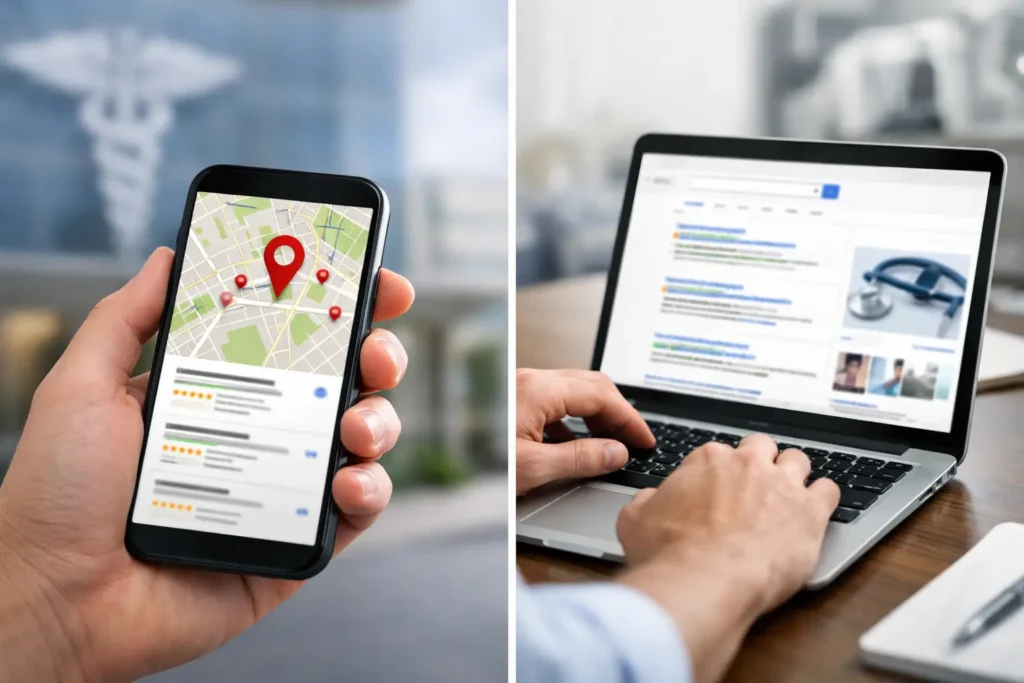
A new patient searches “physical therapist near me” at 8:15 a.m. Another searches for an emergency dentist after lunch. A third compares two therapists before booking an evening consultation. In each case, local SEO versus paid search determines whether your practice appears, how credible it looks, and how quickly that search turns into an appointment.
For healthcare practices, this is not an either-or question as often as it seems. Local SEO builds durable visibility in your service area. Paid search can put your practice in front of high-intent prospects right now. The better choice depends on your market, capacity, timeline, and the specific services you need to grow.
Local SEO Versus Paid Search: The Core Difference
Local SEO helps your practice appear in unpaid search results, especially Google Maps and local organic listings. It is designed to improve visibility when people search for a provider, specialty, treatment, or location near them. Your Google Business Profile, website service pages, reviews, location details, and local authority all contribute to performance.
Paid search, usually through Google Ads, places sponsored listings above or alongside organic results. You bid on relevant searches, such as “chiropractor near me,” “teeth whitening [city],” or “anxiety therapist accepting new patients.” You pay when someone clicks, subject to your campaign settings and budget.
The difference is simple: local SEO earns visibility over time, while paid search buys immediate access to available search traffic. Both can produce qualified leads. Their timing, cost structure, and long-term value are very different.
When Local SEO Is the Stronger Investment
Local SEO is often the foundation of sustainable patient acquisition for a practice with a defined service area. People searching locally are usually not looking for generic healthcare information. They want a provider they can contact, visit, and trust.
A well-optimized local presence gives them the answers they need quickly: where you are located, what you treat, whether you accept their insurance or offer a relevant service, what past patients say, and how to book. When those signals are clear, local search visibility can continue generating inquiries without requiring a payment for every click.
It builds an asset your practice owns
Your website, service pages, location pages, reviews, and local search visibility become more valuable over time. Ranking for terms such as “sports physical therapy in [city]” or “family dentist near [neighborhood]” can create a dependable flow of prospective patients month after month.
That does not mean SEO is free. It requires strategy, content, technical improvements, reputation support, and ongoing refinement. But unlike a paid campaign, visibility does not disappear the moment you pause a daily budget.
It supports the trust patients expect
Healthcare decisions carry more weight than many other local purchases. Patients often compare providers before they call. A complete profile, recent reviews, accurate practice information, thoughtful service pages, and a professional mobile experience can reduce hesitation before a visitor ever submits a form.
This matters especially for therapists, dentists, chiropractors, medical spas, and private practices where the relationship and patient experience heavily influence the decision. Local SEO helps your practice show up as a credible local choice, not just a name in a list.
It is best for long-term market share
If you want to become more visible for multiple services across your city or surrounding communities, SEO provides broader compounding value. A paid campaign might target three high-priority services this month. Local SEO can strengthen your visibility across those services, related questions, branded searches, and map results over time.
The trade-off is speed. Competitive markets rarely produce meaningful organic gains overnight. A new practice or a website with weak local signals may need several months of focused work before it sees consistent improvement.
When Paid Search Makes More Sense
Paid search is valuable when a practice needs visibility quickly and has a clear offer, a strong website experience, and the capacity to respond to leads. It can be especially useful for new locations, seasonal demand, high-value services, or gaps where organic rankings are still developing.
A dentist promoting implants, a med spa filling appointments for a specific treatment, or a physical therapy clinic opening in a new area may not want to wait for local SEO to mature. Paid search can create immediate exposure for relevant searches in a tightly defined location.
It gives you faster control
Google Ads allows you to target specific geographic areas, service categories, schedules, devices, and search intent. If your practice has availability for new patients this month, campaigns can be adjusted to support that goal. If a provider is fully booked, spending can be reduced or redirected.
That control makes paid search a practical tool for managing demand. It can also help you test which services, messages, and calls to action generate the strongest response before you commit to a larger long-term content strategy.
It can be expensive in competitive specialties
The downside is that healthcare-related clicks can be costly, particularly in large metro areas and competitive specialties. A campaign that produces traffic but does not produce booked consultations will drain budget quickly.
That is why the ad is only one part of the system. Your landing page needs a clear service focus, visible contact options, mobile-friendly design, fast load times, and trust signals that match the searcher’s concern. Your front desk or intake team also needs a reliable process for responding promptly. A missed call is not a marketing result.
The Cost Question: Short-Term Spend vs. Long-Term Value
Practice owners often ask which channel costs less. The more useful question is which channel produces the best cost per qualified appointment over time.
Paid search has a direct and visible cost. You can see what you spend, how many clicks you receive, and how many leads are attributed to the campaign. But the true cost includes management, landing page improvements, call handling, and the revenue lost when leads are not followed up quickly.
SEO typically requires a consistent monthly investment rather than a per-click charge. Results take longer, and attribution can be less immediate because patients may find your listing, research your practice later, and convert through a branded search or direct call. Still, strong local rankings can lower your dependency on paid traffic and improve the efficiency of every other marketing channel.
For many practices, the strongest approach is to use paid search for immediate, measurable demand while local SEO builds the visibility that protects future growth.
How to Choose the Right Mix for Your Practice
Start with your business objective, not the marketing channel. If you need to fill appointment openings in the next 30 days, paid search may deserve priority. If you want to build consistent visibility across several neighborhoods and services over the next year, local SEO should be a central investment.
Your website also affects the decision. A slow, outdated site with unclear service information will limit both channels. SEO may bring more visitors, and ads may buy more clicks, but neither solves a conversion problem on its own. Before increasing traffic, make sure patients can understand what you offer and book without friction.
Consider your local competition as well. In a smaller market, a focused local SEO effort may produce substantial results without heavy ad spend. In a dense metropolitan area where established competitors dominate map results, paid search can help you compete while your organic visibility gains traction.
A Practical Growth Plan for Healthcare Practices
The most effective strategy usually begins with a solid local foundation. Your practice information should be accurate everywhere patients find you. Your website should have clear pages for core services, a compelling provider or practice story, easy contact paths, and an experience that works well on a phone. Reviews should be actively earned through an appropriate, patient-centered process.
From there, use paid search selectively. Focus budget on services with meaningful revenue potential, available appointment capacity, and a clear patient journey. Avoid sending every ad click to a generic homepage. Match the ad to a dedicated page that answers the searcher’s question and makes the next step obvious.
Track more than clicks. Measure calls, form submissions, consultation requests, booked appointments, show rates, and cost per acquired patient where possible. If a campaign generates leads that never schedule, investigate the offer, landing page, targeting, and follow-up process before adding more budget.
WebTherapia helps healthcare practices connect these pieces so local visibility, paid campaigns, website performance, and conversion strategy work toward the same outcome: more of the right patients booking care.
The goal is not to win an argument about local SEO versus paid search. It is to create a patient acquisition system that gives your practice immediate opportunities today while making you easier to find, trust, and choose tomorrow.