
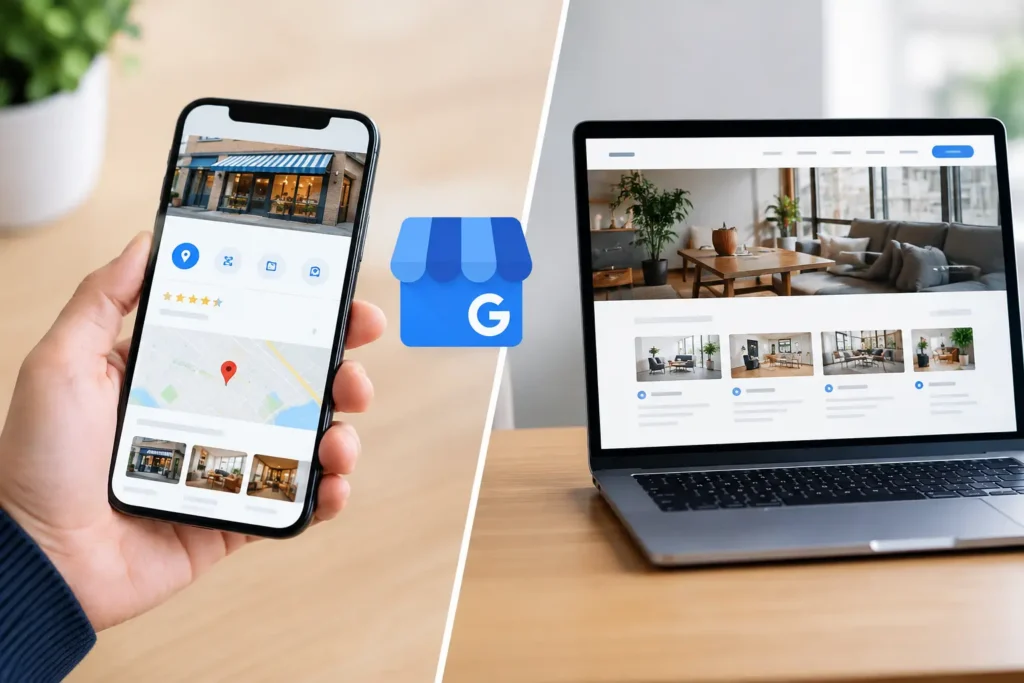
A patient searches “physical therapist near me” between meetings, sees a local result, checks reviews, and calls from their phone. Another patient has a referral for a specific treatment and wants to understand your credentials, approach, insurance options, and availability before reaching out. These are different patient journeys, which is why the Google Business Profile versus website question has no single winner.
For healthcare practices, a Google Business Profile gets you found at the moment of local intent. A website gives patients the confidence and path to take the next step. Relying on only one can limit visibility, trust, and booked appointments.
Google Business Profile vs. Website: The Core Difference
Your Google Business Profile is your practice’s listing in Google Search and Google Maps. It can display your address, hours, phone number, reviews, photos, services, appointment options, and updates. Its primary job is to help nearby patients find and contact you quickly.
Your website is the digital home you control. It explains who you serve, what you treat, why your practice is credible, and how a patient can book. It can rank for a much wider range of searches, including condition-specific, treatment-specific, and location-specific questions that a profile alone cannot fully answer.
Think of the profile as your local search storefront. Your website is the consultation room where prospective patients can learn enough to feel comfortable booking.
When Google Business Profile Does More of the Work
A well-managed Google Business Profile can produce calls and direction requests fast, especially for practices with strong local demand. It is often the first thing a prospective patient sees when they search for a dentist, chiropractor, therapist, med spa, or physical therapist nearby.
It is especially effective for searches with immediate local intent, such as “emergency dentist near me,” “chiropractor open Saturday,” or “med spa in [city].” In these moments, patients want practical answers: where you are, when you are open, whether others recommend you, and how to get in touch.
For a newer practice, optimizing the profile can be one of the fastest ways to establish a visible local presence. Complete categories, accurate service information, current hours, quality photos, and a steady flow of authentic reviews all improve the likelihood that patients will choose your listing over a competitor’s.
But a profile has clear limits. It gives you limited control over layout, messaging, and the patient journey. Google can change features, display competing practices beside yours, or adjust how local results appear. Your profile also cannot replace detailed service pages, provider biographies, educational content, accessibility information, or a conversion-focused booking experience.
When Your Website Carries More Weight
Your website becomes essential when a patient needs more than a phone number. Healthcare decisions involve trust. Someone considering treatment for chronic back pain, anxiety, cosmetic dentistry, pelvic floor therapy, or a skin concern usually needs reassurance before they submit a form or make a call.
A strong practice website answers the questions that stop bookings: Do you treat my concern? Is this provider qualified? What should I expect? Do you take my insurance? Is the office convenient? How do I schedule?
It also gives your practice a foundation for broader search visibility. Individual pages can target the services and communities that matter most to your growth. A physical therapy practice may need pages for sports injury rehabilitation, post-surgical therapy, dry needling, and back pain treatment. A dental office may need pages for implants, Invisalign, emergency dentistry, and family dental care. Those pages create relevant entry points for people who are searching before they are ready to choose a provider.
Most importantly, your website is an owned business asset. You control the content, calls to action, forms, tracking, appointment pathways, and patient experience. You can improve it as your practice grows instead of being confined to the structure of a third-party listing.
The Best Answer Is Usually Both
A Google Business Profile and a website are not competing marketing channels. They perform different jobs in the same patient acquisition system.
Your profile captures high-intent local demand and supplies quick trust signals through ratings, reviews, location, and recent activity. Your website supports that decision with deeper information and a clear path to book. In many cases, a patient will move between both several times. They may discover your profile in Maps, visit your website to review services and providers, then return to Google to read more reviews before contacting the practice.
This is why consistency matters. Your practice name, phone number, address, hours, services, and provider details should align across both. A mismatch creates uncertainty for patients and can weaken local search signals. If your website says you are accepting new patients but your profile shows outdated hours or an old phone number, you may lose a call that should have become a booking.
What Healthcare Practices Should Prioritize First
The right starting point depends on your current situation. If you already have a credible, conversion-ready website but your Maps visibility is weak, your Google Business Profile likely needs immediate attention. If your profile gets views and calls but patients are not converting consistently, the website may be the missing piece.
For practices building from scratch, establish both at the same time. Launching a profile without a professional website can make your practice look incomplete. Launching a website without a verified, optimized profile can make it harder for local patients to find you when they are ready to act.
Start with a clear local foundation: accurate business information, the correct primary category, appropriate service categories, professional photos, and a process for requesting reviews ethically. Then make sure the website has dedicated service pages, provider credibility, mobile-friendly contact options, and clear appointment calls to action.
For healthcare marketing, avoid treating reviews as a passive outcome. Create a compliant, repeatable process for inviting satisfied patients to share feedback without pressuring them or disclosing protected health information. Respond professionally to reviews without confirming that a reviewer is a patient. Trust is built not only by the number of stars, but also by how responsibly your practice manages its public reputation.
Common Mistakes That Reduce Calls and Bookings
One common mistake is viewing the Google profile as a substitute for a website. A listing may generate calls, but it cannot fully differentiate a practice in a competitive market. Patients comparing several providers need a reason to choose you.
Another is investing in a polished website that is difficult to find locally. If your local profile is incomplete, unverified, or associated with inconsistent information, the website may not receive the qualified local traffic it deserves.
Practices also lose opportunities by sending every visitor to a generic homepage. A patient searching for “TMJ treatment” should arrive on a page that directly addresses TMJ care, not a broad page that forces them to hunt for answers. The same applies to searchers looking for a specific provider, service, or location.
Finally, do not let either asset go stale. Outdated holiday hours, old staff photos, broken forms, unreturned calls, and neglected reviews communicate the wrong message before a patient ever walks through your door.
Build a Patient Journey, Not Just a Presence
The goal is not to choose between Google and your website. The goal is to make it easy for the right patient to find your practice, trust your expertise, and book without friction.
Use your Google Business Profile to show up where local decisions begin. Use your website to turn that attention into confidence and action. When both are accurate, persuasive, and built around real patient questions, your online presence becomes more than a listing or a brochure. It becomes a dependable source of qualified inquiries and appointments.
The next patient searching for care is not looking for a marketing strategy. They are looking for a practice that feels credible, accessible, and ready to help. Make sure every search path gives them a clear reason to choose yours.